


Managers have an important role in keeping children and adults at risk safe. But does every manager need Level 3 safeguarding training?
Safeguarding training for managers should match their responsibilities, sector and relevant UK guidance. Level 3 may be appropriate for managers overseeing safeguarding concerns or supporting staff with complex cases. However, not every manager legally requires a Level 3 certificate, and some designated safeguarding roles need additional specialist training.
The right choice depends on what you are responsible for, not simply your job title.
Strengthen your safeguarding knowledge
A course for managers.
What Level of Safeguarding Training Do Managers Need?
Managers need safeguarding training that prepares them to fulfil their responsibilities confidently and appropriately.
For example, a team leader responsible for recognising concerns and supporting staff may have different learning needs from a registered care manager overseeing safeguarding procedures, referrals and organisational responses.
In England, the Care and Support statutory guidance identifies several types of safeguarding learning, including basic awareness, specialist training for managers and advanced training for people handling complex enquiries.
The guidance does not establish one universal numbered course level for every manager.
Before choosing training, consider whether your responsibilities include:
- Recognising and escalating safeguarding concerns.
- Supervising staff who work with adults or children at risk.
- Overseeing safeguarding policies and reporting arrangements.
- Supporting decisions involving complex concerns.
- Working with safeguarding partners or external agencies.
- Reviewing incidents and improving safeguarding practice.
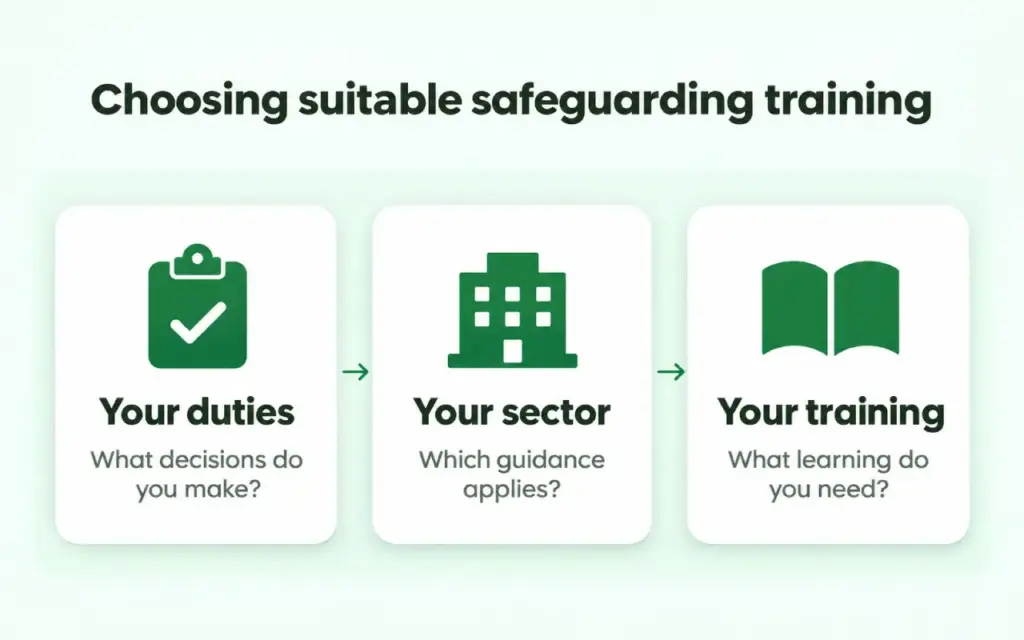
Managers with greater decision-making or oversight responsibilities may need specialist development beyond general awareness training.
Level 2, Level 3 or Advanced Safeguarding Training?
Safeguarding courses are commonly described using levels, but these labels do not form one universal UK training system. Employers and training providers may use different frameworks.
The following comparison is a general guide, not a statutory classification..
| Training Type | Typical Learning Focus | Who May Benefit? |
|---|---|---|
| Basic awareness or Level 2 | Recognising concerns, understanding responsibilities and following reporting procedures | Staff and supervisors with routine safeguarding duties |
| Level 3 safeguarding | More detailed safeguarding knowledge, risk assessment, reporting and coordinated responses | Managers, senior practitioners and some safeguarding leads |
| Advanced or specialist training | Complex decisions, specialist enquiries, leadership and safeguarding governance | Designated specialists and managers with complex responsibilities |
Basic Awareness and Level 2 Safeguarding
Basic safeguarding training helps staff recognise potential harm, respond appropriately to concerns and understand their organisation’s reporting procedures.
Some employers use Level 2 training for employees who need more detailed knowledge because of their work.
However, the content attached to a particular level should always be checked. A course labelled Level 2 by one provider may not match another organisation’s competency framework.
Level 3 Safeguarding for Managers
Level 3 safeguarding training generally offers more detailed coverage of safeguarding responsibilities, legislation, risk assessment and responding to concerns.
It may be relevant for managers who supervise staff, oversee reporting procedures or contribute to safeguarding decisions.
However, completing a Level 3 course does not automatically establish competence for every managerial or designated safeguarding role.
The training must cover the responsibilities expected by the employer and relevant professional framework.
Advanced or Specialist Safeguarding Training
Some managers need additional learning because they oversee complex enquiries, manage safeguarding arrangements or hold specialist responsibilities.
This could involve advanced safeguarding, management supervision, inter-agency procedures or role-specific leadership development.
The important question is whether the training prepares the manager for their actual duties, rather than whether its title contains the highest level.
What Safeguarding Training Is Suitable for Different Managers?
Different management positions involve different safeguarding decisions. Understanding those differences makes training selection more practical.
Care Home Managers and Registered Managers
In England, managers may also need to cooperate with local authorities during Section 42 enquiries, where the relevant legal criteria apply.
Skills for Care’s manager induction standards address responsibilities including recognising abuse, information sharing, managing concerns and learning from safeguarding incidents.
Managers should therefore consider training that develops both safeguarding knowledge and the ability to oversee safe practice.
Level 3 may support this learning, but additional management-specific training may be necessary.
Effective safeguarding leadership also involves making safeguarding personal, ensuring that adults’ views, wishes and desired outcomes inform decisions wherever appropriate.
Team Leaders and Service Managers
Team leaders often provide the first point of support when staff raise safeguarding concerns.
Their responsibilities may include checking that concerns are recorded, ensuring reporting procedures are followed and escalating issues appropriately.
Managers must also help staff recognise and report safeguarding concerns promptly, following their organisation’s procedures.
Consider a newly promoted care team leader who previously completed basic safeguarding awareness training.
Their new position involves supervising employees and reviewing safeguarding records. They should ask their employer whether their previous training still meets the responsibilities of their role.

This is a hypothetical example, but it illustrates why promotion can change training needs.
School, Nursery and Education Managers
Safeguarding expectations in education differ from those in adult social care.
In England, schools and colleges must follow the Department for Education’s safeguarding guidance. Managers should receive training relevant to their duties, while designated safeguarding leads have additional responsibilities.
A headteacher, nursery manager and designated safeguarding lead may therefore require different combinations of safeguarding learning.
Education professionals should check the guidance applying to their particular setting before selecting training.
Charity and Community Organisation Managers
Managers in charities and community organisations may work with children, adults at risk or both.
Their training needs depend on the organisation’s activities, the people it supports and the manager’s safeguarding responsibilities.
For example, someone managing an administrative team may need different training from a manager directly supervising services for adults at risk.
Organisations should assess those responsibilities and arrange suitable training rather than assuming that everyone in management needs the same course.
Is Safeguarding Level 3 Mandatory for Managers in the UK?
No single UK-wide legal requirement says that every manager must complete a course labelled Level 3 safeguarding.
Specific duties and training expectations vary between sectors and jurisdictions.
England: Role-Specific Safeguarding Requirements
In regulated health and social care services in England, CQC Regulation 13 requires providers to protect people from abuse and improper treatment.
CQC’s guidance says safeguarding training must be relevant and suitable for staff members’ roles, with updates at appropriate intervals.
This is different from requiring every manager to obtain the same commercial training certificate.
For schools and colleges, Keeping Children Safe in Education 2026 establishes safeguarding responsibilities, including specific training expectations for designated safeguarding leads.
Managers must consider the requirements applying to their own setting.
Wales, Scotland and Northern Ireland
Safeguarding arrangements also differ across the other UK nations.
- Wales: Social Care Wales uses safeguarding practitioner groups A–F, with learning expectations linked to responsibilities.
- Scotland: The Scottish Government’s Adult Support and Protection learning framework supports role-appropriate training across relevant organisations.
- Northern Ireland: The Department of Health’s adult safeguarding policy framework establishes a separate approach to protecting adults at risk.
Managers should check the applicable national and local arrangements instead of assuming that an England-focused course level applies throughout the UK.
Is Safeguarding Training for Managers the Same as DSL Training?
No. General safeguarding training for managers and training for a Designated Safeguarding Lead (DSL) serve related but different purposes.
A manager may oversee staff, implement policies and monitor safeguarding practice without holding the designated safeguarding-lead role.
A DSL has specific responsibilities for managing safeguarding and child protection arrangements within their setting.
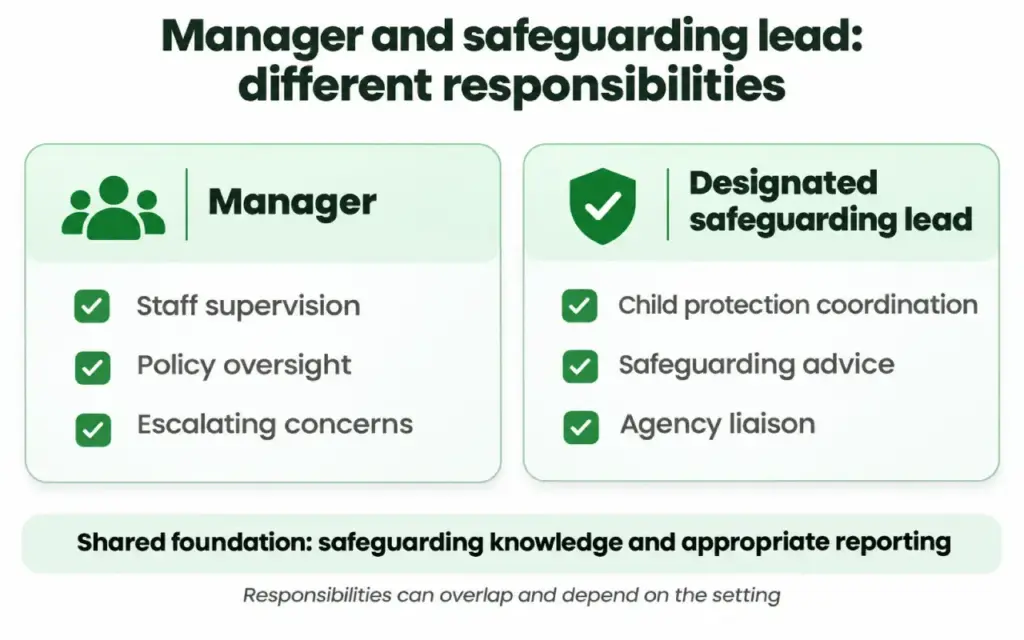
In English schools and colleges, Keeping Children Safe in Education 2026 expects DSLs and their deputies to receive training that equips them for their duties. That training should be updated at least every two years.
A general Level 3 safeguarding course does not automatically meet every aspect of those expectations.
Managers appointed as DSLs should confirm whether they need additional role-specific training, local safeguarding procedures training or other professional development.
The distinction is between understanding safeguarding responsibilities and being prepared to carry out a designated safeguarding role.
How Often Should Managers Refresh Safeguarding Training?
There is no universal renewal period for every safeguarding certificate or every management position.
Training updates depend on the relevant sector guidance, employer policies, responsibilities and changes in safeguarding practice.
For example, English school and college DSL training should be updated at least every two years. Adult social care providers must ensure staff receive appropriate safeguarding updates, but CQC Regulation 13 does not impose one identical certificate-renewal period on all managers.
Managers should also maintain knowledge between formal courses through supervision, policy updates, team discussions and learning from incidents.
A certificate’s stated validity period should not be confused with a universal legal requirement to retrain.
Strengthen your safeguarding knowledge
A course for managers.
Considering an Online Level 3 Safeguarding Course?
Managers seeking additional safeguarding knowledge can consider LIBM’s Level 3 Safeguarding Children & Vulnerable Adults course.
The online programme covers safeguarding legislation, recognising abuse, responding to disclosures, reporting concerns, risk assessment and record keeping.
LIBM offers flexible, self-paced online learning covering key safeguarding topics. Before enrolling, check that the course content and assessment methods meet your learning needs and any training requirements set by your employer.
The course should be considered educational training, not automatically a regulated qualification or a substitute for specialist training required by an employer.
Choosing the Right Safeguarding Training
The most suitable safeguarding training is the training that matches your responsibilities.
Before enrolling, check your role, sector-specific guidance and employer expectations. Level 3 may be appropriate, but some managers need additional specialist learning.
The aim is not simply to hold a certificate. It is to have the knowledge and competence to help protect people effectively.
Frequently Asked Questions
Do all managers need Level 3 safeguarding training?
No. Training requirements depend on a manager’s responsibilities, sector, employer and applicable guidance. Some managers need specialist safeguarding training, while others may require general awareness and role-specific updates.
Is Level 3 safeguarding training enough for a care home manager?
Not necessarily. Level 3 may support relevant knowledge, but care home managers must also meet applicable safeguarding responsibilities. Additional leadership, supervision or local procedures training may be needed.
Can managers complete safeguarding training online?
Yes. Online courses can support safeguarding knowledge and professional development. However, managers may also require practical learning, supervision or specialist training to fulfil their responsibilities.
Is Level 3 safeguarding the same as DSL training?
No. DSL training focuses on designated safeguarding responsibilities. A Level 3 safeguarding course does not automatically satisfy every requirement of a designated safeguarding-lead role.
How often should safeguarding training for managers be renewed?
There is no single UK-wide renewal period. Managers should follow applicable sector guidance and employer requirements, and update their knowledge whenever responsibilities or safeguarding arrangements change.
Does Level 3 safeguarding training count as a qualification?
Not automatically. A course described as Level 3 may award a completion certificate or CPD recognition rather than an Ofqual-regulated qualification. Check the awarding organisation and qualification status before relying on it professionally.
- All Courses
- Health & Social Care128
- Career and Employability102
- Business Skills85
- Management and Leadership77
- Lifestyle72
- Health & Safety72
- Accounting & Bookkeeping64
- IT & Digital Skills63
- Psychology & Counselling56
- Personal Development55
- Teaching & Education43
- Marketing and Sales40
- Awarding Body37
- Health & Fitness31
- Human Resource31
- Design & Creative27
- Construction & Property26
- Language23
- Investing & Trading23
- Microsoft Office Skills23
- Academic & Exam Preparation22
- Administration & Office Skills22
- Beauty & Well-Being21
- Legal & Compliance19
- Animal Care18
- Project Management18
- AI ~ Artificial Intelligence17
- Travel, Tourism & Hospitality12
- Food Hygiene & Safety3